
Twenty two. That is the number of American veterans who die by suicide every single day. Not every week. Not every month. Every day. Men and women who survived combat, who came home, who made it through the thing that was supposed to be the hardest part, and then lost the battle in the quiet of civilian life.
Most people hear that number and feel a wave of sadness followed by a familiar helplessness. It is too big. Too complex. Too entrenched in systems and bureaucracies and mental health infrastructure that moves slowly when it moves at all.
John Chmela heard that number and started inviting veterans to fish on his lake.
It sounds almost too simple. That is exactly the point.
How a Horse Farm Became a Veterans Sanctuary
Chmela did not set out to build a veteran advocacy program. He set out to buy a horse farm because his wife had a dream and he had the means to make it real. What happened next was not part of any plan.
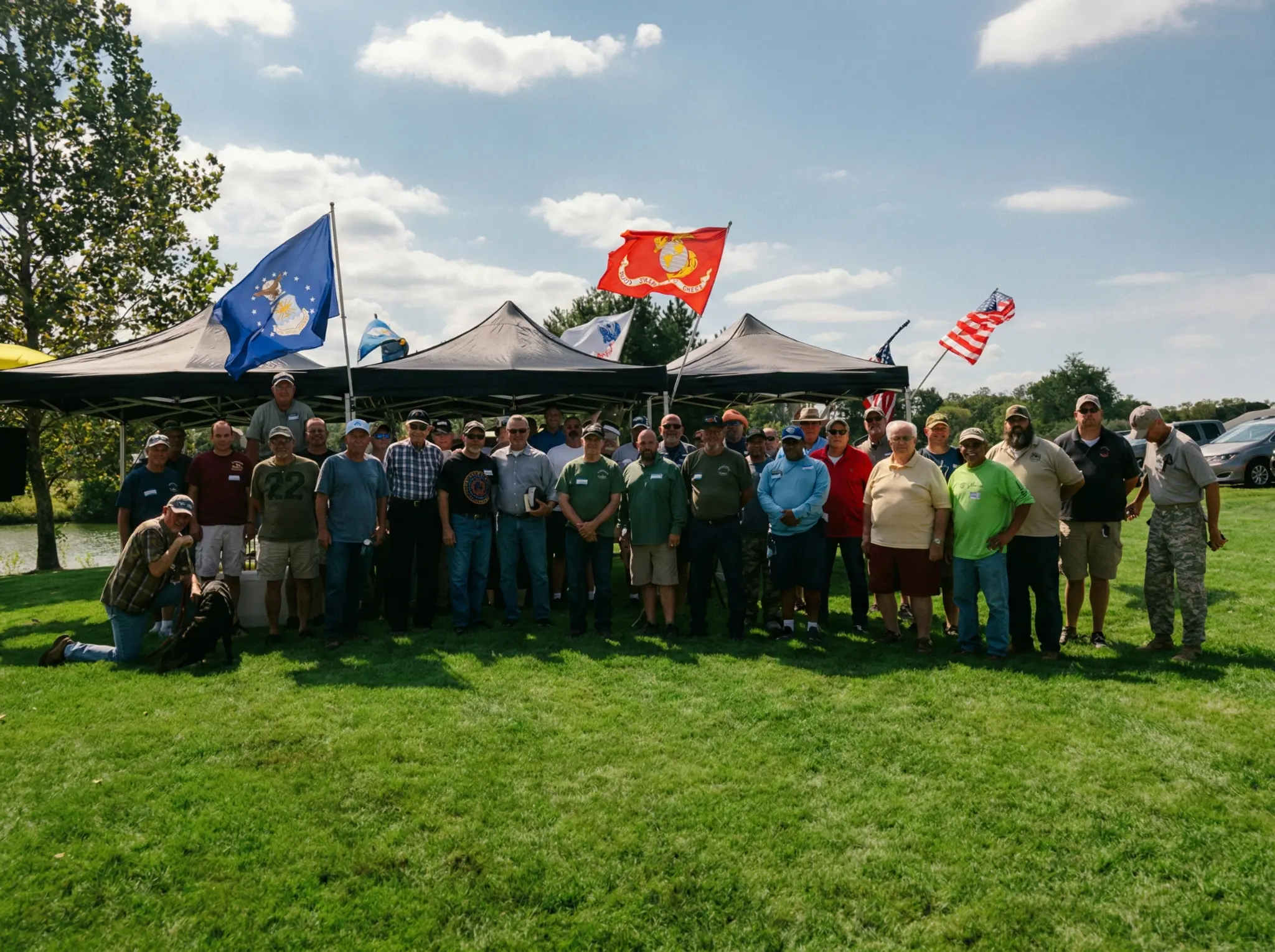
Charities started calling. They had heard about the farm, about the forty acre lake sitting in the backyard of Queenslake Horse Farm in Georgetown, Kentucky, and they had an idea. Could they bring veterans out for a few days? Just to fish. Just to be somewhere peaceful with other people who understood what they had been through.
Chmela said yes. And then he started paying attention to what happened when they showed up.
What he observed was not complicated but it was profound. Veterans who arrived carrying the weight of PTSD, of paranoia, of addiction, of the particular kind of loneliness that comes from feeling fundamentally misunderstood by the world around them, those veterans visibly changed when they were surrounded by other veterans. The guard came down. The isolation broke. Something that had been locked tight started to loosen.
He kept saying yes. And then he started building something intentional around what he was seeing.
The 90 Day Clock That Changes Everything
The science behind what Chmela observed is more specific than most people realize. It is not simply that veterans feel better around other veterans, though that is true. It is about a very particular window of time and what happens when that window closes.
Veterans dealing with PTSD, addiction, paranoia, and other service connected conditions face a compounding problem. Each of those conditions is treatable in isolation. There are therapies, medications, programs, and interventions that work. But all of that progress becomes dramatically less effective when the veteran spends extended time alone.
The threshold that Chmela references is ninety days. If a veteran at risk goes ninety days or more in isolation, the psychosis that accompanies suicidal ideation becomes extremely difficult to escape. The odds shift sharply in the wrong direction. The interventions that would have worked at thirty days or sixty days lose most of their power at ninety.
This is why the fishing trips matter. Not because fishing is therapeutic, though being outdoors and away from the noise of everyday life certainly does not hurt. They matter because they reset the clock. They break the isolation before it crosses the threshold that makes everything else so much harder.
Chmela built his entire veteran program around this single insight. Get them together before the ninety days runs out. Keep doing it. Make it easy, accessible, and free so that the barrier to showing up is as low as possible.
What the Programs Actually Look Like
The fishing retreats were the beginning. What Queenslake Horse Farm offers veterans today has grown considerably from those first informal gatherings by the lake.
Chmela hosts veteran appreciation dinners where anyone who has served can come and eat well, listen to live music, and spend an evening in the company of people who share a common bond. These are not small affairs. Steak dinners, concerts in front of the lake, evenings designed to feel like celebration rather than charity.
He opened a veterans home on the property. If a veteran is homeless and wants to live with other veterans, there is a place for them at Queenslake. The home is built on the same principle as everything else. Put veterans in proximity to each other. Let the community do what programs and paperwork cannot.
The horse arena on the farm, which seats a thousand people, gets opened to any veteran focused charity that needs a space. No charge. No complicated application process. The space exists and the need exists and Chmela sees no reason to put anything between those two facts.
And then there is the Mogadishu Mile, which deserves its own conversation entirely. An annual event that has grown every year since it started, drawing veterans, civilians, sponsors, and media together around an act of shared physical challenge and deliberate remembrance.
The Results That Cannot Be Argued With
Chmela is careful not to overstate what he knows and what he does not. He is not running a clinical trial. He does not have a control group. What he has is something simpler and in some ways more powerful.
He has no reports of any veteran actively engaged in his programs who is even depressed, let alone suicidal.
That is not a small thing. These are veterans who arrived carrying real burdens. PTSD. Addiction. Isolation. The kind of pain that the system has often failed to reach. And the ones who keep showing up, who stay connected to the community being built at Queenslake, are not falling through the cracks.
He is clear that this works on a small scale right now. Georgetown, Kentucky is not the whole country. One farm, one lake, one community cannot reach twenty two veterans a day. But the model itself, the idea that proximity and community and regular human contact can interrupt the cycle before it becomes irreversible, that model scales.
The Vision That Keeps Him Up at Night
Chmela wants a hundred of these farms. Not a hundred programs that look like his on paper but function like bureaucracies in practice. A hundred actual farms, with actual land and actual lakes and actual communities built around the same simple principle. Get veterans together before the clock runs out.
He is already looking at properties. He already has the blueprint. What he does not yet have is the financial backing to move at the speed the problem demands. Every horse farm he has looked at comes with a price tag in the tens of millions. The math is real and the barrier is real.
But so is the urgency. Twenty two veterans a day is not a statistic that allows for patience. It is a number that demands that anyone with the means to help and the model that works moves as fast as possible.
What One Man With a Lake Proved Is Possible
John Chmela did not set out to solve veteran suicide. He set out to honor the people who showed up at his door and asked for a place to exist for a few days without the weight of the world pressing down on them.
What he proved, almost by accident, is that the solution hiding inside the most devastating mental health crisis facing American veterans is not primarily pharmaceutical or clinical or governmental. It is human. It is the simple and ancient thing that has always been true about people in pain. They get better when they are not alone.
The lake helped. The horses helped. The steak dinners and the concerts and the free place to sleep helped. But underneath all of it, what actually moved the needle was the presence of other veterans who understood without explanation what it meant to carry what they were carrying.
John Chmela gave them a place to find each other. And so far, not one of them has been lost.
