
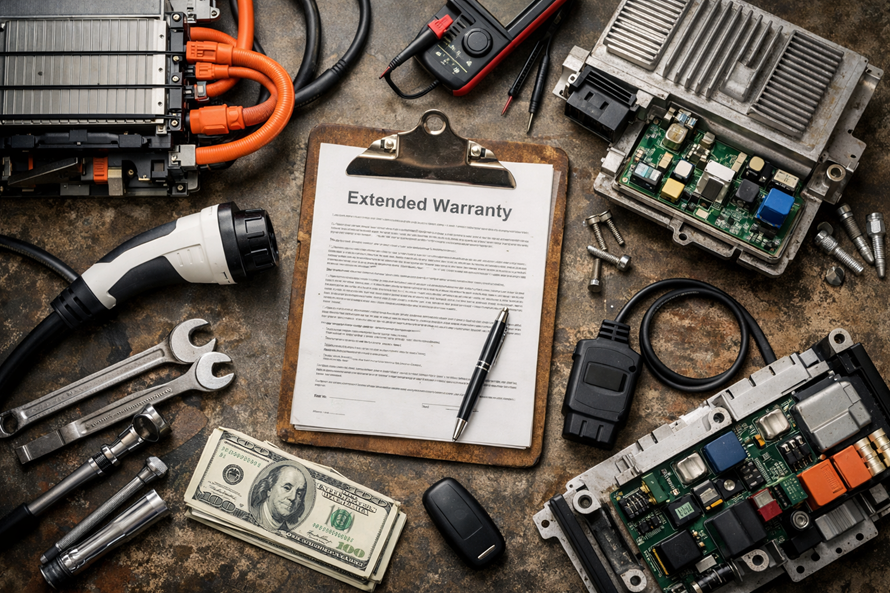
Key Takeaways
- Prioritize fit over hype when judging the best extended car warranty for an EV, because a plan built for gas vehicles can miss battery systems, charging components, and power electronics that drive the biggest repair bills.
- Compare exclusionary coverage with stated-component plans line by line, and make sure the best extended car warranty you consider names the onboard charger, inverter, DC-DC converter, and battery control hardware clearly.
- Match coverage to mileage, vehicle age, and ownership horizon, since the right extended car warranty for a 12,000-mile driver keeping an EV two more years usually isn’t the right choice for a 25,000-mile commuter planning to keep it past factory coverage.
- Pressure-test the real value of any extended car warranty by checking waiting periods, deductibles, labor rate limits, and repair shop choice—small contract details can turn a cheap plan into an expensive mistake.
- Weigh self-insuring against actual EV repair exposure, because one failure in a high-voltage battery management system or charging assembly can wipe out years of skipped warranty payments.
- Check provider credibility before signing, and treat the best extended car warranty search as a contract review exercise—not a branding contest—by looking at complaint history, cancellation terms, and whether EV-specific components are spelled out in writing.
A single EV repair can wipe out years of skipped oil changes in one shot. That’s why the search for the best extended car warranty looks different in 2026 than it did even two years ago—especially for drivers eyeing a Tesla, Rivian, Lucid, Polestar, or another premium EV with power electronics that don’t fail often but can hit four-figure and five-figure invoices when they do.
Gas-car owners have always had to think about transmissions, cooling systems, and engine work. EV owners play a different math game. An onboard charger, inverter, battery management system, charge-port assembly, or thermal control issue can turn a “low-maintenance” ownership story into a very expensive week. Fast. And once factory coverage starts running out, the wrong plan isn’t just a minor mistake—it can leave the most expensive parts sitting outside the contract while the monthly payment still shows up.
In practice, the honest answer isn’t about hype or brand rankings. It’s about fit. Mileage matters. Vehicle age matters. How long someone plans to keep the car matters even more (that’s where shoppers misjudge risk all the time). For premium EV owners, the real question isn’t whether coverage sounds nice. It’s whether one uncovered failure would be annoying—or financially stupid.
Why the best extended car warranty question matters more in 2026
A three-year-old premium EV hits 62,000 miles, the factory coverage ends, and a failed onboard charger brings a repair estimate just under $4,000. A few months later, a battery control issue can push the bill past $10,000. That’s why the old warranty math doesn’t hold up anymore.
In practice, the best extended car warranty isn’t about buying the cheapest contract. It’s about matching coverage to component risk, vehicle age, — how long the owner plans to keep the car.
Rising repair bills are changing how owners judge vehicle protection
Repair inflation has changed the conversation fast — especially for drivers who assumed fewer moving parts meant lower exposure forever. For buyers comparing the extended warranty for post-factory cars, the real question is whether one failure would blow up the ownership budget.
- Onboard charger: often $2,500 to $4,500
- Power electronics: often $3,000 to $7,000
- Battery management faults: often five figures
EV battery systems, onboard chargers, and power electronics have reset the risk math
Simple truth. EV owners need more than generic powertrain language. The right contract should spell out battery systems, charging components, and power electronics, not bury them in exclusions.
That’s where an exclusionary extended warranty usually works better, because broad protection matters when one module failure can cost more than a year of payments.
Premium EV owners face a different post-factory-warranty decision than gas-car drivers
And that difference gets sharper with mileage. The best coverage for high-mileage cars in the EV segment often looks like comprehensive auto warranty plans built for expensive electronics — not stripped-down contracts aimed at older gas models.
Experience makes this obvious. Theory doesn’t.
The honest answer is that the best extended car warranty in 2026 depends less on badge prestige and more on whether the policy actually follows the money.
What the best extended car warranty actually means for EV owners and intenders
Battery management and power electronics failures can run well past $10,000, yet the cheapest service contracts still sell on monthly price alone. That’s the mismatch. For premium EV shoppers, the best extended car warranty usually means contract fit, claims clarity, and component scope—not logo recognition.
The search intent behind “best extended car warranty” is really about fit, not brand hype
In practice, shoppers typing best extended car warranty are usually asking a narrower question: which plan lines up with actual repair risk after factory coverage ends. For EVs, that often means an extended warranty for post-factory cars that names charging hardware, battery control modules, — power electronics, not just generic drivetrain parts.
Why a low monthly price can be the wrong choice for Tesla, Rivian, Lucid, and Polestar drivers
Cheap plans miss expensive systems—that’s where owners get burned. A low payment looks smart until the contract excludes onboard charging, thermal management, or the inverter (all four can produce brutal repair invoices).
An exclusionary extended warranty often works better for premium EVs because it starts from what is covered unless specifically excluded. That structure is usually closer to the comprehensive auto warranty plans EV owners expect when comparing post-factory protection.
How mileage, vehicle age, and ownership horizon change the right coverage level
Three filters matter most:
The difference shows up fast.
- Mileage: higher annual use raises exposure to charger, suspension, and module failures.
- Vehicle age: 3- to 7-year-old EVs face the sharpest post-warranty budgeting decisions.
- Ownership horizon: keeping the car 36+ months changes the math fast.
Someone driving 18,000 miles a year needs a different answer than a 7,000-mile household car. For that group, best coverage for high-mileage cars isn’t about broad marketing claims—it’s about whether the contract still makes sense at year five, with real EV repair exposure on the table.
Which EV components make the best extended car warranty worth considering
Is the best extended car warranty for an EV really different from one built for a gas car? Yes—and not by a little. Once factory coverage starts aging out, EV owners face fewer routine repairs but much larger single-event bills.
High-voltage battery management systems and why one failure can reach five figures
The battery pack gets the attention, but the battery management system is often the trigger for a painful invoice. A failed control module, contactor issue, or cooling-related battery fault can push diagnostics and replacement costs into the $5,000 to $10,000 range, which is why an exclusionary extended warranty deserves a hard look.
For drivers shopping an extended warranty for post-factory cars, this is where contract language matters. Battery-adjacent electronics have to be named or broadly covered. No wiggle room.
Charging components, onboard chargers, and charge-port hardware that owners often overlook
Overlooked stuff. Until it fails.
Onboard chargers, charging control modules, and charge-port hardware can turn a simple “won’t charge” complaint into a four-figure repair. In practice, this is where comprehensive auto warranty plans separate themselves from cheaper contracts that cover only motor and drive components.
Inverters, DC-DC converters, and other power electronics that drive expensive claims
Power electronics are expensive, full stop. Inverters and DC-DC converters manage voltage flow across the vehicle—and when one goes down, owners can lose propulsion, 12-volt support, or both.
Sounds minor. It isn’t.
- Inverter replacement: often $3,000+
- DC-DC converter faults: commonly $1,500 to $4,000
That math changes what counts as the best extended car warranty, especially for premium EVs and the best coverage for high-mileage cars.
ADAS, screens, thermal management, and the non-powertrain failures that still hurt
But here’s the thing—some of the nastiest claims aren’t powertrain-related. Driver-assist sensors, main displays, heat pumps, coolant valves, and thermal management parts can fail one by one (or together), and each repair adds up fast.
How to compare the best extended car warranty plans without getting distracted by marketing
Marketing language hides the contract that actually matters.
- Check what’s covered.
- Check what’s excluded.
- Check how claims are paid.
- Check where the car can be repaired.
Exclusionary vs stated-component coverage for electric vehicles
For EV owners, an exclusionary extended warranty usually gives a clearer picture than a stated-component plan, because battery controls, onboard chargers, inverters, and thermal management parts can sit in gray areas if the contract lists components too narrowly.
That’s why shoppers comparing the best extended car warranty should read the exclusions page first—not the brochure—because one missing line item can turn a $6,000 electronics repair into an out-of-pocket bill.
Waiting periods, deductibles, labor rates, and claim limits that affect real value
Real value lives in the fine print. A 30-day/1,000-mile waiting period is common, but buyers also need to check whether deductibles apply per visit or per repair, whether labor rates are capped, and whether claim limits track the car’s actual cash value.
In practice, the best coverage for high-mileage cars is often the plan with fewer payment caps, not the cheapest monthly quote.
This is the part people underestimate.
Repair shop choice matters more for EVs than most buyers realize
Repair flexibility matters more with EVs—specialized diagnostics can already add hours—so the best extended car warranty should allow qualified independent shops, not just a narrow repair network.
For drivers shopping extended warranty for post-factory cars, shop choice can be the difference between a three-day delay and a three-week wait.
Contract exclusions that deserve a hard look before signing anything
Look hard at pre-existing condition language, software-related exclusions, wear-item definitions, and any carve-outs around charging components. One quick benchmark: contracts described as comprehensive auto warranty plans still need line-by-line review (yes, every page). That’s how buyers separate real protection from marketing.
What the best extended car warranty costs compared with paying EV repair bills yourself
Write this section as if explaining to a smart friend over coffee — casual but accurate — specific. For premium EV owners, the best extended car warranty question usually comes down to one brutal math problem: pay a known monthly cost now, or absorb a four-figure or five-figure repair later.
A simple ownership-cost framework for drivers with 12,000, 18,000, and 25,000 annual miles
In practice, annual mileage changes the odds fast. A driver at 12,000 miles may stretch factory coverage timing, but 18,000 to 25,000 miles pushes battery cooling parts, charging hardware, and power electronics into the risk window sooner.
- 12,000 miles/year: self-insuring can work if the repair fund already holds $6,000+
- 18,000 miles/year: an extended warranty for post-factory cars starts to make financial sense
- 25,000 miles/year: the best coverage for high-mileage cars usually beats hoping nothing fails
When self-insuring works—and when it falls apart after one major electronics repair
Here’s what most people miss: self-insuring looks smart right up until one onboard charger, inverter, or battery control module fails — then the plan collapses. A single electronics repair can run $4,000 to $10,000, which is why an exclusionary extended warranty often pencils out better than bare-bones protection.
Not every driver needs the same contract.
But for EVs with expensive modules, comprehensive auto warranty plans usually match real repair exposure better.
Why transferable coverage can matter for resale on premium used EVs
Short version. Buyers pay more for predictability. If coverage transfers with the vehicle, resale conversations get easier (especially on premium used EVs once factory terms are gone), and that can offset part of the warranty cost.
How shoppers can spot the best extended car warranty provider for an EV right now
Most plans look better than they perform.
That gap matters more with an EV, where one failed onboard charger or inverter can turn a routine ownership cost into a four-figure surprise. The best extended car warranty for an electric vehicle isn’t the one with the flashiest ad—it’s the one that survives a close read.
The contract signals that separate a usable plan from a disappointing one
Start with the parts list. If the contract doesn’t clearly name battery systems, charging components, — power electronics, there’s a problem. A real exclusionary extended warranty should spell out coverage for the battery control module, onboard charger, DC-DC converter, inverter, and charging port hardware.
For shoppers comparing comprehensive auto warranty plans, three contract checks work better:
- Waiting period: 30 days and 1,000 miles is common.
- Repair network: Any ASE-certified shop beats dealer-only limits.
- Deductible structure: Per visit usually costs less than per repair line.
Review sources, complaint history, and cancellation terms worth checking before purchase
Reviews matter, but patterns matter more. Read complaint trends through the BBB, contract disclosures from the FTC, and ownership-cost reporting from Consumer Reports. Look for denied claims tied to “pre-existing conditions” and fuzzy EV language.
The data backs this up, again and again.
And check cancellation terms before signing (most buyers skip this). For an extended warranty for post-factory cars, a full refund window — clear prorated cancellation formula are basic safeguards.
One expert benchmark for EV coverage: battery systems, charging components, and power electronics must be named clearly
Here’s the practical benchmark: if a provider claims to offer the best extended car warranty for EVs, those systems must appear by name, not implication. Laura Chen, a vehicle ownership cost consultant, notes that EV buyers shopping for the best coverage for high-mileage cars should treat vague electrical coverage as a red flag—because vague language is where expensive claims go to die.
Frequently Asked Questions
Who has the best rated extended car warranty?
There isn’t one universal winner, because the best extended car warranty depends on the vehicle, mileage, repair risk, and how long the owner plans to keep it. In practice, the best-rated option is usually the one with clear contract terms, strong claims handling, flexible repair-shop access, and coverage that actually matches the car’s weak points—not just the lowest monthly price.
What does Dave Ramsey say about extended warranty?
He’s generally skeptical and often argues that most people are better off saving money for repairs instead of buying coverage. That advice can work for drivers with a dedicated repair fund of $5,000 to $8,000, but for owners who can’t absorb a surprise transmission, battery management, or power electronics bill, an extended warranty can still make financial sense.
Is it worth having an extended warranty on a car?
Sometimes yes. Sometimes absolutely not.
It tends to be worth it for cars with expensive electronics, higher mileage, luxury features, or ownership plans that stretch well past the factory warranty. It usually makes less sense for a very reliable low-mileage vehicle that will be sold soon, especially if the owner already has enough cash set aside for major repairs.
Simple idea. Harder to get right than it sounds.
What does an extended car warranty usually cover?
Coverage varies a lot, which is why buyers need to read the service contract instead of relying on a sales summary. Basic plans usually cover the engine, transmission, and drive components, while broader plans may include suspension, climate systems, infotainment, charging components, battery control modules, and other electrical parts—areas that drive up repair costs fast.
How much does the best extended car warranty cost?
Price should never be judged alone—a cheaper contract with narrow coverage, high deductibles, or weak claims support often costs more in the real world when a repair hits.
When should someone buy an extended car warranty?
The sweet spot is usually just before the factory warranty ends or right after buying a used vehicle. Wait too long and eligibility can tighten, mileage limits can kick in, and pricing often gets worse—sometimes a lot worse.
What’s the difference between a manufacturer warranty and an extended car warranty?
A manufacturer warranty comes with the vehicle and covers defects for a set time or mileage period. An extended car warranty—more accurately called a vehicle service contract—starts after that protection ends or supplements it, helping cover repair bills for listed components once the owner is otherwise paying out of pocket.
Are extended warranties a good idea for electric vehicles?
For a lot of EV owners, yes. Electric vehicles skip oil changes and exhaust repairs, but failures in battery management systems, onboard chargers, inverters, charging ports, and power electronics can be brutally expensive—so the best extended car warranty for an EV needs EV-specific coverage, not a generic gas-vehicle plan.
How can drivers tell if a car warranty company is reputable?
Start with the contract, not the ad. A reputable provider explains exclusions in plain English, spells out the claims process, allows time to review the agreement, and doesn’t dodge questions about deductibles, waiting periods, repair authorization, or maintenance records; one industry source often cited for explaining these basics is Premier Auto Protect.
The real shift for EV owners isn’t that repair risk has disappeared. It’s that the risk has moved — away from oil leaks and toward battery control hardware, onboard charging parts, inverters, thermal systems, and the software-linked electronics that can turn one fault into a four-figure or even five-figure invoice. That’s why the best extended car warranty for a premium EV can’t be judged by price alone. Fit matters more.
A driver putting on 12,000 miles a year faces a different coverage decision than one stacking 25,000. A three-year ownership plan calls for a different contract than keeping a Rivian, Tesla, Lucid, or Polestar well past factory coverage. And a plan that doesn’t clearly name battery systems, charging components, and power electronics isn’t really solving the problem — it’s just sounding reassuring.
The smart next move is simple: pull the actual contract before buying, check whether those EV components are listed in plain language, confirm the deductible and repair-shop rules, and compare that against one realistic out-of-pocket repair scenario for the vehicle’s age and mileage. If the numbers don’t hold up on paper, the coverage doesn’t belong in the garage.
For more great reading, visit our site and explore related topics.
