
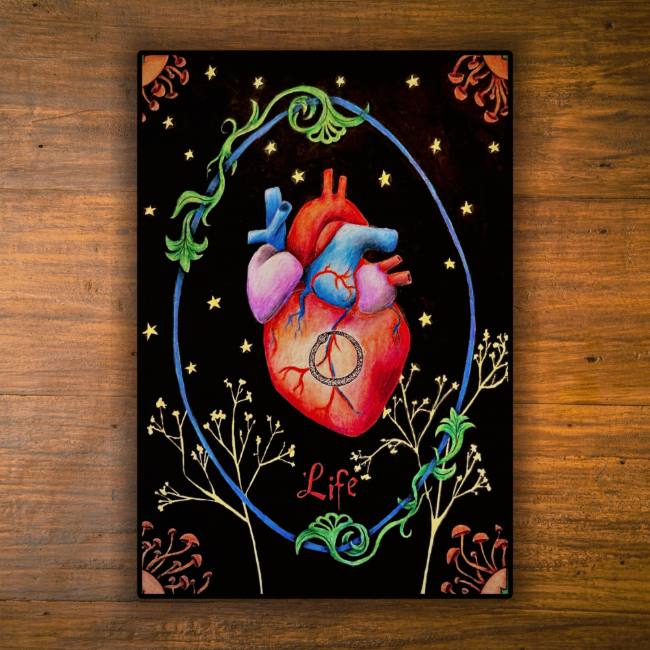
On Life, Jeremy Parsons does not rush to conclusions. Instead, he lingers in questions, letting them unfold slowly, sometimes uncomfortably, across five spare, thoughtfully constructed songs. It’s an EP shaped by interruption—written during the pandemic, when momentum stalled and reflection became unavoidable—but it resists the temptation to dramatize that pause. Parsons’ achievement here is restraint: he trusts the weight of lived experience, delivered plainly, to carry meaning.
Parsons has long been an Americana songwriter inclined toward self-examination, but Life feels unusually distilled. There’s little ornamentation in the production, little posturing in the performances. What remains are songs that treat time, memory, and moral reckoning not as concepts to be explained, but as realities to be endured.
The EP opens with “Tickin’,” built around the most familiar of symbols: the clock. Yet Parsons avoids melodrama. Time, in his telling, is neither villain nor savior; it simply exists. “It’s not wasted if you choose to learn,” he sings, offering a line that lands less like advice than acknowledgment. The lyric does not erase regret, nor does it sanctify it. Instead, it reframes experience as accumulation rather than loss. The song’s calm insistence mirrors its message: awareness, not panic, is the point.
“The Garden” extends that philosophy through metaphor. Drawing on imagery rooted in growth and cultivation, Parsons asks what is being nurtured—and what is being neglected—in a life. The song’s refrain, “I hope that means you are too,” is quietly empathetic, suggesting care without intrusion. Unlike much contemporary songwriting that treats introspection as confession or spectacle, Parsons’ approach here is conversational. He does not demand identification; he invites it.
The emotional center of the EP arrives with “Who Was I,” a reflective look at Parsons’ younger self. At 25, he depicts himself as drifting, numbing days and nights while his parents followed a more conventional path of faith, family, and stability. The song’s most striking line—“Sometimes I wonder who’s chasing who, me or the dream”—captures the ambiguity of ambition without resolving it. There is no neat redemption arc. Instead, Parsons allows contradiction to stand: aspiration and avoidance, freedom and disorientation, coexist without explanation. The song’s power lies in its refusal to romanticize either side.
With “Humanity,” Parsons turns outward, though not grandly. Rather than constructing a protest anthem, he offers a lament. “I saw that humanity was dying inside them,” he sings, addressing a culture frayed by judgment and noise. The critique is subdued but pointed. Parsons implicates himself as much as others, acknowledging limitation rather than claiming authority. The song suggests that the erosion of empathy is not caused by a single force but by accumulation—small acts of dismissal, repeated until they harden into habit.
The EP closes with “Life Worth Dyin’ For,” a title that risks sentimentality but largely avoids it. Parsons frames the song as a reckoning rather than a celebration, listing moments of laughter, love, failure, and persistence. The refrain—“Oh, I lived a life worth dying for”—is not triumphant. It sounds more like acceptance, offered without certainty. There is no promise of legacy here, only a recognition of presence: a life fully inhabited, however imperfectly.
What distinguishes Life is its refusal to overstate its significance. Parsons does not attempt to summarize the pandemic, solve cultural division, or resolve personal history. Instead, he documents the act of living through uncertainty and coming out with questions intact. The songs favor clarity over catharsis, patience over proclamation.
In a musical landscape often dominated by urgency and declaration, Life feels almost radical in its stillness. Jeremy Parsons is not trying to persuade or impress. He is listening—to time, to memory, to his own contradictions—and allowing listeners to do the same.
John Parker
